
Biological control has emerged as a fundamental pillar of integrated pest and disease management in modern agriculture. Its application allows reducing the use of synthetic chemical products, protecting the environment and favoring sustainable production systems. Conceptually, biological control can be defined as the use of living organisms or their by-products to reduce the population or damage caused by pests and diseases. In this context, biological control agents (BCA) can exert their action through two main mechanisms: direct and indirect.
Direct biological control mechanisms
Direct mechanisms involve a physical or biochemical interaction between the CBA and the pathogen or pest. Classic examples include:
- Competition for space and nutrients: Trichoderma spp.. efficiently colonizes space in the rhizosphere, displacing pathogens such as Fusarium spp.
- Antibiosis: production of secondary metabolites by certain microorganisms capable of inhibiting the growth or killing pathogens such as Botrytis spp, Monilia spp. or Fusarium spp.
- Parasitism: some strains of Trichoderma produce lytic enzymes that degrade the cell walls of pathogenic fungi.
While these mechanisms are widely studied and used, indirect mechanisms have attracted increasing interest because of their impact on plant defensive physiology.
Indirect mechanisms: The role of the plant immune system.
Unlike direct mechanisms, indirect mechanisms do not act on the pathogen, but modulate the immune response of the plant, strengthening its defense capacity against future attacks. This interaction generates a real “training” of the plant immune system that strengthens the plant’s defenses in a systemic way(Induction of Systemic Resistance, ISR), preparing it to respond more quickly and effectively to an attack, a phenomenon known as Priming.
Constitutive and inducible defenses
Plants have constitutive defenses (structural and chemical defenses always present) and inducible defenses, activated in response to an attack. Within the latter we find:
- Secondary metabolites: alkaloids (nicotine, caffeine), glucosinolates, among others.
- Defense proteins: pathogenesis-related proteins (PR) and protease inhibitors, which negatively affect the digestive capacity of herbivorous insects.
- Programmed cell death: isolation of infected areas to slow the spread of the pathogen.
- Attraction of natural enemies: through the emission of volatile compounds, the plant recruits auxiliaries that attack pest insects.
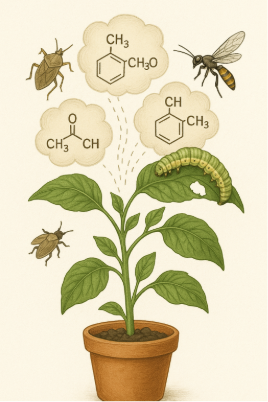
Examples of induction of resistance by microorganisms:
Beneficial microorganisms such as Trichoderma spp., mycorrhizae and PGPR bacteria are able to induce resistance in plants by different mechanisms. Trichoderma spp. when inoculated in roots, can generate a systemic resistance that protects even aerial organs from foliar fungal diseases such as Botrytis spp. reducing symptoms and improving the overall plant condition (Martinez-Medina et al., Frontiers Plat Sci, 2013). In addition, this interaction also triggers the production of toxic metabolites that negatively affect the survival of herbivorous insects, thus limiting the damage caused by these organisms.
In turn, mycorrhizae, once established in the roots, influence the development of the insects that feed on them, synthesizing secondary metabolites and various compounds that cause their reduced growth and even a reduction in the feeding rate (Rivero et al., 2021).
Against nematodes, Trichoderma spp. activate systemic defenses that reduce the formation of galls on roots, limiting the impact of these parasites (Martínez-Medina et al., New Phytol, 2017). In addition, mycorrhizae stimulate the release of volatile compounds that act as chemical signals of attraction for natural enemies of pests, favoring a more effective and balanced biological control.
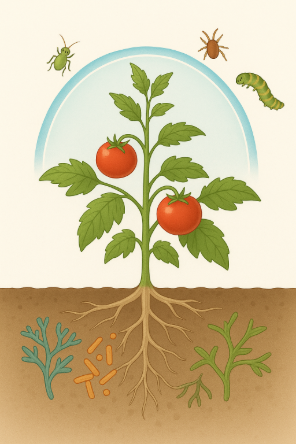
Priming: Intelligent pre-activation of eefenses
Priming represents a state of alertness of the plant defense system, ready to respond quickly and effectively when it detects an attack. Unlike a permanent defense, priming saves energy, since it is only activated when necessary. Beneficial microorganisms induce this state very efficiently:
- In the absence of attack, no significant increase in defensive metabolites such as jasmonic acid is detected.
- After the presence of the attacker, the inoculated plant shows an accelerated and potent production of these compounds.
- In mycorrhizal plants, the accumulation of callose is also observed, limiting the advance of pathogenic fungi.
Moreover, this phenomenon not only affects the direct response of the plant, but also the attraction of auxiliaries through the increased emission of volatile compounds.
Conclusions
Scientific evidence confirms that resistance induction by microorganisms is a real, effective and multifaceted process. ISR and Priming, stimulated by microorganisms such as Trichoderma spp., mycorrhizae and PGPR, not only reinforce natural plant defenses, but also integrate natural enemies into a cooperative defense system.
Beyond pest and disease control, these mechanisms contribute to more sustainable agricultural management, increasing yields, protecting biodiversity and reducing dependence on chemical inputs. Soil care and the promotion of healthy microbiota will be key to maintaining and enhancing these benefits over time.

