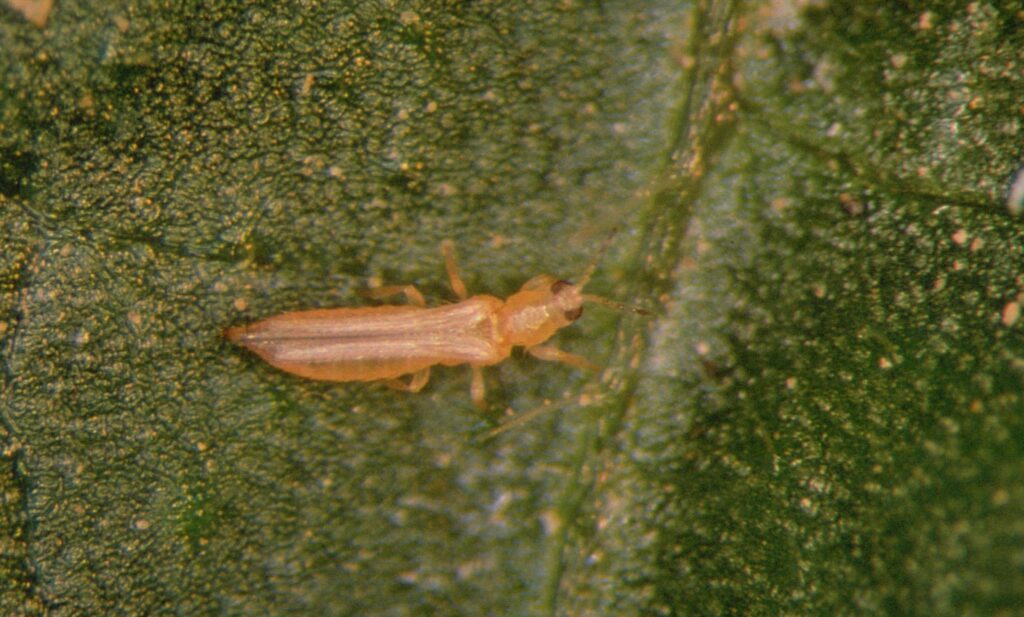
Climate change is profoundly altering the dynamics of agricultural pests, and thrips are one of the clearest examples of this transformation. Rising average temperatures, shorter cold periods, and the increasing frequency of warm weather events favor their development, accelerate their life cycle, and extend their activity throughout the year. As a result, the number of generations per growing season increases, leading to steadily greater pest pressure on crops.
This climatic scenario is further reinforced by the global spread of invasive species associated with the international trade of plant material. In Spain, species such as Scirtothrips dorsalis, Scirtothrips aurantii, and Thrips parvispinus have become established in recent years, the latter posing a particularly serious threat to greenhouse vegetable crops in southeastern Spain. Their preference for warm climates suggests that their distribution is likely to expand progressively under ongoing global warming.
All evidence suggests that thrips will cease to behave as a seasonal pest and will become a structural component of Mediterranean agriculture. Understanding the influence of climate on their biology is key to anticipating risks and developing more effective and sustainable management strategies.
What Are Thrips?
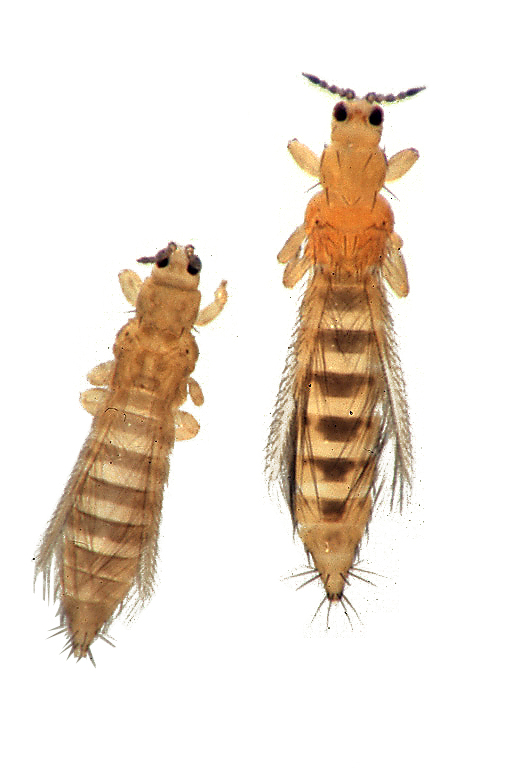
Thrips are insects belonging to the order Thysanoptera, a name derived from the Greek words meaning “fringed wings,” referring to the fine hair-like structures that line the edges of their wings. They typically measure only one to two millimetres in length, making them almost invisible to the naked eye.
They have elongated bodies and vary in colour from pale yellow to dark brown or black. Most thrips species are phytophagous, feeding on plants, although some species are fungivorous or predatory. Their piercing-sucking mouthparts allow them to puncture plant cells and extract their contents, causing cumulative damage that often remains unnoticed until populations are already well established.
Although their flight capacity is limited, their dispersal by wind currents enables them to rapidly colonize new fields and greenhouses.
The Most Agriculturally Important Thrips Species
Of the more than 5,000 described species, only a small number are responsible for the vast majority of agricultural damage:
Frankliniella occidentalis, It is the most widespread thrips species worldwide due to its highly polyphagous nature and remarkable ability to develop insecticide resistance. Its international spread was closely linked to the global trade of cut flowers, particularly chrysanthemums, which facilitated its dispersal from its native range in western North America to greenhouses across virtually every continent within just a few decades.
Thrips tabaci, commonly known as the onion thrips, comprises a complex of populations with variable biological characteristics. Some of these populations are efficient vectors of viruses such as Iris yellow spot virus (IYSV), extending their phytosanitary significance well beyond Allium crops.
Thrips parvispinus, native to Asia, is a particularly aggressive invasive species. Its high reproductive rate and strong adaptation to warm climates have facilitated its rapid spread throughout intensive Mediterranean horticulture, where it is causing significant damage to vegetable crops.
Scirtothrips aurantii, commonly known as the South African citrus thrips, is one of the smallest thrips species, measuring less than one millimetre in length. It primarily causes cosmetic damage to fruit, reducing its commercial value. Males can be identified by the presence of claspers (drepana), a distinctive morphological feature within the genus. Its impact is greatest during periods of abundant young plant tissue, such as shoot flush and fruit set, particularly under warm conditions, which increase the incidence of superficial fruit damage.
A Life Cycle Designed for Rapid Multiplication
The success of thrips is largely explained by their life cycle. Females lay their eggs inside plant tissues, where they are protected from adverse environmental conditions and plant protection treatments.
After hatching, the larvae pass through two active feeding stages during which they feed intensively, causing most of the damage to the crop. They then develop into prepupae and pupae, typically in the soil or in protected areas of the plant, where they are difficult to reach with control measures. Finally, they emerge as mobile adults capable of dispersing and colonising new host plants.
Under optimal conditions, between 20 and 30 °C, the life cycle can be completed in less than two weeks, allowing multiple generations to develop within a single growing season. In addition, many species are capable of reproducing by parthenogenesis, further accelerating population growth and the spread of infestations.
Damage to Crops
Direct damage appears as silvery or bronze discoloration on leaves and fruits, resulting from the destruction of plant cells. These affected areas exhibit a characteristic light-reflecting appearance due to the loss of cellular contents and are often accompanied by tiny black specks corresponding to insect excrement. Severe infestations can lead to distorted shoots and permanent scarring of the fruit.
In citrus crops, species of the genus Scirtothrips feed beneath the calyx of newly set fruit, causing lesions that expand as the fruit develops, ultimately reducing its commercial quality.
Indirect damage is equally significant. Thrips are vectors of viruses such as Tomato spotted wilt virus (TSWV), adding an important phytosanitary dimension to their impact. Larvae acquire the virus while feeding, and once they reach adulthood, they transmit it to healthy plants, making disease management considerably more challenging.
In addition, some thrips species interfere with pollination by feeding on floral pollen, thereby reducing fruit set. The overall impact is not always reflected in lower yields; more often, it results in a loss of product quality that directly affects the crop’s economic value and profitability.
Direct damage
- Silvery or bronze discoloration on leaves and fruits
- Black specks (frass) adjacent to the lesions
- Deformation of young shoots and leaves
- Permanent scarring that reduces fruit quality
Indirect Damage
- Transmission of plant pathogenic viruses such as Tomato spotted wilt virus (TSWV)
- Reduced fruit set due to interference with pollination
- Overall plant stress, increasing its susceptibility to other pests and diseases
- Loss of commercial value without necessarily reducing crop yield
Management and Control Strategies
Thrips management requires an integrated approach based on the combined use of complementary control strategies. The progressive withdrawal of available active substances, together with the limited number of effective alternatives, has made control increasingly difficult, turning thrips management into a long-term structural challenge rather than an occasional problem.
Monitoring is the first pillar of an integrated management programme. The use of coloured sticky traps, together with regular inspection of young shoots and flowers, allows early detection of thrips populations and timely intervention before they reach damaging levels.
Cultural control forms the preventive foundation of an integrated management strategy. It includes the removal of crop residues, weed management to eliminate potential pest reservoirs, the use of certified plant material, and the maintenance of optimal irrigation and nutritional balance. Plants under stress are significantly more susceptible to thrips infestations.
Biological control is an essential component of integrated pest management, relying on natural enemies such as predatory mites of the genera Amblyseius and Neoseiulus, as well as entomopathogenic fungi such as Beauveria bassiana, to help suppress and stabilise thrips populations.
Chemical control should be regarded as a complementary tool within an integrated management programme. Its effectiveness depends on the appropriate rotation of active substances to minimise the risk of resistance development and on targeting applications at the larval stages, which are the most susceptible. Active ingredients such as spinosad, spinetoram, acetamiprid, flupyradifurone, and sulfoxaflor have demonstrated good efficacy, particularly when incorporated into integrated pest management programmes.
The Future and Evolution of Thrips as an Agricultural Pest
Thrips management is evolving towards increasingly predictive approaches, based on climatic data, digital trapping systems, and sensor technologies that enable population increases to be anticipated before they become visible in the field.
These advances are complemented by new tools based on biological inputs, semiochemicals and behavioural interference strategies, as well as the development of crop varieties with improved tolerance to thrips through plant breeding.
Thrips are no longer considered a secondary pest but have become a structural challenge in intensive agriculture. Their management no longer relies on isolated interventions, but on the integration of agronomic knowledge, technology, and well-planned management strategies.
In the context of climate change, the key will be to anticipate their population dynamics in order to protect crop quality and ensure the profitability of agricultural production.

